Transport for London's Amy Edgar Talks Neuroinclusion: NeuroPlaces Insights
Amy Edgar, Customer Diversity and Inclusion Specialist at Transport for London (TfL), plays a vital role in shaping one of the world's most complex public transport networks to be more inclusive and accessible for all users. As a valued member of the NeuroPlaces' Advisory Board, Amy brings extensive expertise in inclusive design, accessibility strategy, and the practical realities of delivering change at scale.

We spoke to Amy to explore how TfL is approaching neuroinclusion, the progress being made, and what truly inclusive transport systems need to consider moving forward.
To start, please tell us a bit about your role at TfL and how neuroinclusion fits into your work?
I am a Diversity and Inclusion Specialist siting in the Customer D&I team. I currently lead strategic direction and day‑to‑day performance of TfL’s Independent Disability Advisory Group (IDAG), ensuring the organisation benefits from members’ diverse expertise and lived experience when shaping the transport network. My work focuses on improving the customer experience for disabled and neurodivergent people who use TfL services.
I oversee internal communications and engagement for the Inclusive Design Centre for Excellence and currently developing a long‑term training strategy with specialist partners to build inclusive design capability across customer‑facing teams. I also provide expert advice on a wide range of projects, policies and programmes to help ensure accessibility and neuroinclusion are embedded from the earliest stages.
Are there any particular parts of the journey where TfL sees the biggest challenges for neurodivergent passengers?
From our research we see the biggest challenges for neurodivergent passengers tend to be around moments of unpredictability or sensory overload. Navigating stations can be particularly challenging, as complex layouts, unclear wayfinding and the cognitive effort required to process information can quickly become overwhelming. Crowded platforms often add to this pressure by creating sensory overload and a sense of having little control, especially when it’s not clear where to seek help.
Boarding can sometimes be difficult, with some people feeling rushed to move quickly while also dealing with noise and confusion. Disruptions or rerouting can be especially anxiety inducing, as sudden changes or unclear instructions are harder to process in the moment. Throughout the journey, interactions with other passengers can also create stress, particularly when there is a fear of judgement, conflict or being misunderstood.
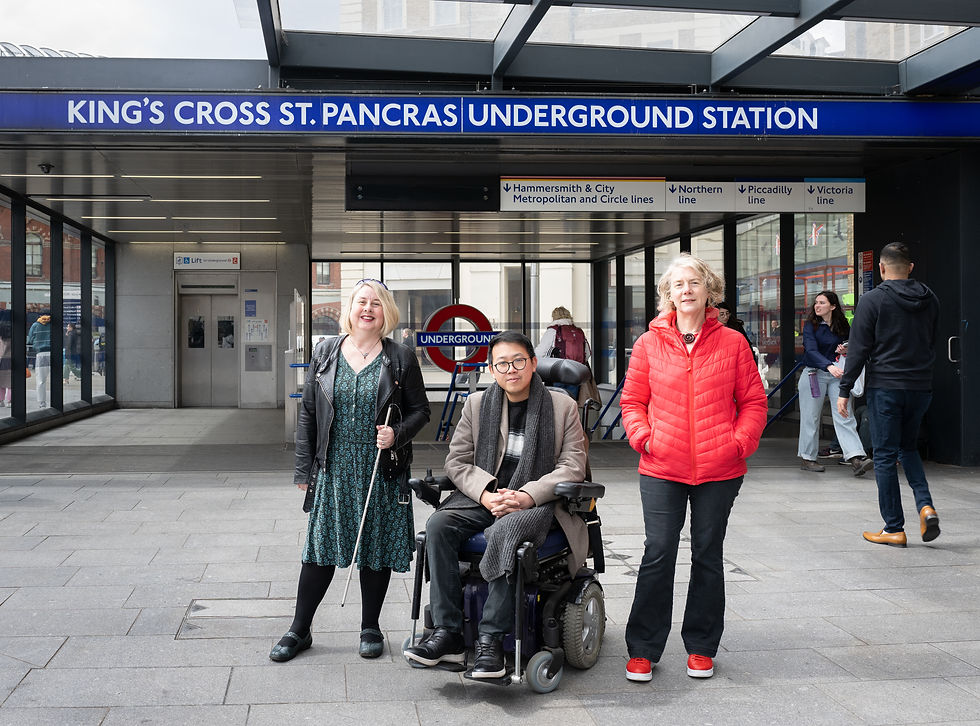
Can you shed some light on areas where TfL are currently exploring or piloting more neuroinclusive approaches?
Equity in Motion is an intersectional plan that prioritises addressing barriers to transport rather than focusing solely on individual characteristics. By shifting the emphasis from specific disabilities to the systemic obstacles that create exclusion, the plan ensures a more inclusive transport network for everyone.
Equity in Motion builds on existing initiatives that support neurodivergent customers, including travel mentoring to reduce anxiety, priority seating and badges for non-visible disabilities, and assistance services like Turn Up and Go and Access DLR. We’ve improved station signage and wayfinding, offer accessible journey planning tools such as TfL Go, and provide virtual station tours via Google Street View at several stations across Central London. Frontline staff receive disability equality training, while efforts to reduce noise on the Tube and review street design to help minimise sensory challenges.
TfL recently launched its Inclusive Design Centre for Excellence, a vehicle for change, driving TfL towards a future where inclusive design underpins everything it does. It will help to create an ecosystem that enables inclusive design to flourish through the sharing and continuous development of knowledge and expertise.
We are currently exploring options on what a calm and safe space looks like in station environments, this work will be informed by people with lived experience of neurodivergence, including but not limited to autism, ADHD, and dementia.
In what way does lived experience of neurodivergent people inform the projects that you are working on?
TfL’s Independent Disability Advisory Group (IDAG) brings together 12 experts appointed specifically for their professional and lived experience of disability such as sensory or mobility impairments, mental health, specific learning difficulties, or a combination. Their insights help us look beyond basic compliance and think creatively about how our network can meet diverse needs, shaping the policies, projects and long‑term planning support.
Alongside this, our Inclusive Transport Forum brings pan‑London and national accessibility advocates together to share lived‑experience perspectives, including from neurodivergent communities. Their contributions help us understand how design decisions, customer information and operational approaches impact people with different processing or sensory profiles.
Finally, the All Aboard Panel of 200 disabled Londoners provides regular, practical feedback through surveys and journey shadowing. This gives us robust, real‑world evidence about barriers faced by neurodivergent customers, which we use to guide improvements across our projects.

We have spoken a lot about neuroinclusion for your passengers, what does neuroinclusion internally look like at TfL for employees?
TfL is embedding neuroinclusion across the organisation through enhanced disability training that covers non‑visible conditions, neuroinclusive recruitment processes with built‑in adjustments, and consistent tailored support from our workplace adjustments team. Our programmes like Steps into Work help neurodivergent young people into employment, and colleague groups such as the Disability Network continue to shape policy and practice. This work is supported by strong governance through TfL’s Disability Confident Leader accreditation and ongoing efforts to ensure inclusive, accessible workplaces.
Looking ahead, what are the key priorities for TfL when it comes to neuroinclusion over the next 5-10 years?
Over the next decade, TfL’s key neuroinclusion priorities focus on embedding inclusive design across the organisation, through the new Inclusive Design Centre of Excellence, and improving the customer experience with clearer, more personalised travel information and better‑equipped frontline staff. TfL also aims to make stations and vehicles easier to navigate and less cognitively demanding, creating environments that reduce sensory overload and support a wider range of neurological needs.
How do you believe that partnerships — like the one with NeuroPlaces — help TfL move this vital work forward?
Partnerships like our collaboration with NeuroPlaces play a vital role in moving this work forward. They help us reach more neurodivergent people, enabling us to share information about the support available to help them travel confidently, while also having the opportunity to connect with specialist experts and gaining lived experience insight that strengthens our approach. Ultimately, partnerships like this enable us to deliver a more inclusive, welcoming transport system for everyone.
Amy's insights highlight the scale of opportunity — and responsibility — involved in creating transport systems that are truly inclusive for neurodivergent people. Through collaboration, innovation, and lived-experience informed design, organisations like TfL are helping shape more accessible public spaces.
At NeuroPlaces, we are proud to work alongside experts like Amy and our wider Advisory Board to drive conversations, share best practice, and support the development of more neuroinclusive public environments.
With thanks to Amy for sharing her insights on this topic.


Comments